Fly Ash Brick Weight vs Pallet Strength: Load per Pallet & Right Thickness Guide
Fly ash brick manufacturers often ask us two questions before ordering pallets: how many bricks can one pallet carry, and which thickness should we buy? Most plant owners assume that because bricks are heavy, the pallet must be thick and strong enough to hold their weight.
The weight of the bricks, however, is rarely what damages a pallet. Machine vibration, hydraulic pressing, lifting, water curing and rough handling wear pallets out much faster. This blog explains, with simple calculations, how much load a fly ash brick pallet really carries and how to choose the right thickness for your machine.
How Much Does a Fly Ash Brick Weigh?
The standard fly ash brick size used in India is 230 × 110 × 70–75 mm. A fresh brick of this size, straight off the machine, weighs around 3 to 3.5 kg.
The weight varies because every plant uses a slightly different mix, and some machines compact the brick more than others. A denser brick is a heavier brick.
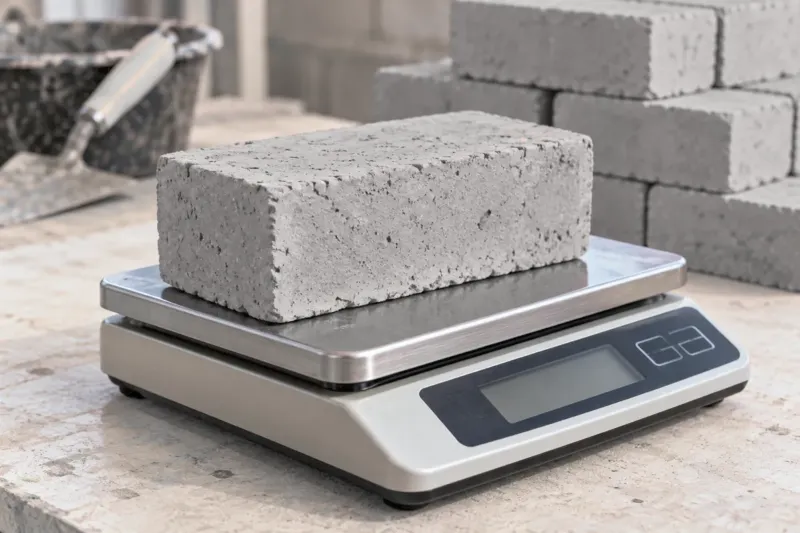
For pallet selection, always take the weight of a fresh brick straight off the machine. A fresh brick still holds water from the mix, so it is heavier than a cured brick, and that is the brick your pallet carries.
How Many Bricks Sit on One Pallet?
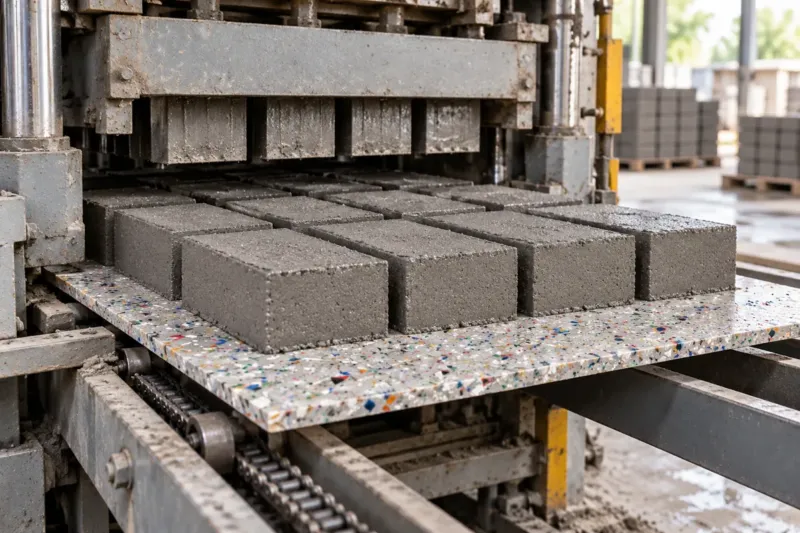
The number of bricks on a pallet is decided by the machine, not by the pallet. Every stroke of the mould places a fixed number of bricks on the pallet, and this count depends on the machine model and mould design.
So the pallet must match the mould. It should be slightly larger than the mould area so that every brick rests fully on the pallet surface. This is why fly ash brick pallets are made in many sizes. EcoRight pallets manufactured by AS Polywood Industries are available in:
- 600 × 600 mm and 610 × 610 mm
- 560 × 850 mm
- 850 × 540 mm
- 900 × 400 mm and 30 × 24 inches
- Custom sizes as per your mould
If you are not sure about your pallet size, just share your machine model or mould size with us and we will match it.
How Much Load Does a Pallet Actually Carry?
Once you know the brick weight and the number of bricks per stroke, the load calculation is simple. Here are two examples:
| Example | Bricks per Stroke | Weight per Fresh Brick | Load on Pallet |
|---|---|---|---|
| Example 1 | 10 | 3.0 kg | 10 × 3.0 = 30 kg |
| Example 2 | 12 | 3.5 kg | 12 × 3.5 = 42 kg |
In both cases the load is less than one 50 kg cement bag.
Now compare this with the strength of the pallet material. In a lab test at CIPET, Bhopal (a Government of India institute), the material of EcoRight pallets manufactured by AS Polywood Industries showed a compressive strength of 50.17 N/mm². In simple terms, every square millimetre of the material can take about 5 kg of pressure before it crushes.
A 3 kg brick resting on its 230 × 110 mm face puts only about 0.0001 kg on each square millimetre. That is tens of thousands of times below the material’s limit. So the weight of the bricks alone does not break a good quality pallet.
What Actually Damages Fly Ash Brick Pallets?
If brick weight is not the problem, what wears pallets out? The answer lies in what a pallet goes through in every production cycle.
1. Machine Vibration
Brick machines vibrate hard to compact the fly ash mix. The pallet sits directly under the mould and takes this vibration on every single stroke, all day long.
2. Hydraulic Pressing
On hydraulic and fully automatic machines, the press pushes down on the mix while the pallet supports it from below.
3. Bending During Lifting
When a worker or stacker lifts a loaded pallet from the sides, the centre of the pallet sags. If it sags too much, the fresh bricks can crack before they even reach the curing area.
4. Water During Curing
Pallets remain wet for long periods during water curing. Wooden and plywood pallets absorb this water, swell and lose their shape, which leads to uneven bricks.
5. Rough Handling
Pallets are dropped, dragged and knocked against each other at every plant. The edges and corners take most of this damage.
Out of these five, only pressing is related to load. The rest depend on how stiff the pallet is, whether it absorbs water, and how well it handles impact. These are the points to compare when choosing a pallet.
Why Pallet Thickness Matters
Thickness decides how stiff a pallet is, and stiffness increases much faster than thickness. When a board becomes twice as thick, it becomes about 8 times harder to bend, because bending stiffness grows with the cube of thickness.
- Example: A 25 mm pallet is roughly 9 times stiffer than a 12 mm pallet of the same material.
- Simple test: Hold a thin plastic ruler and a thick plastic chopping board by their ends and press the middle. The ruler bends easily, while the chopping board hardly moves.
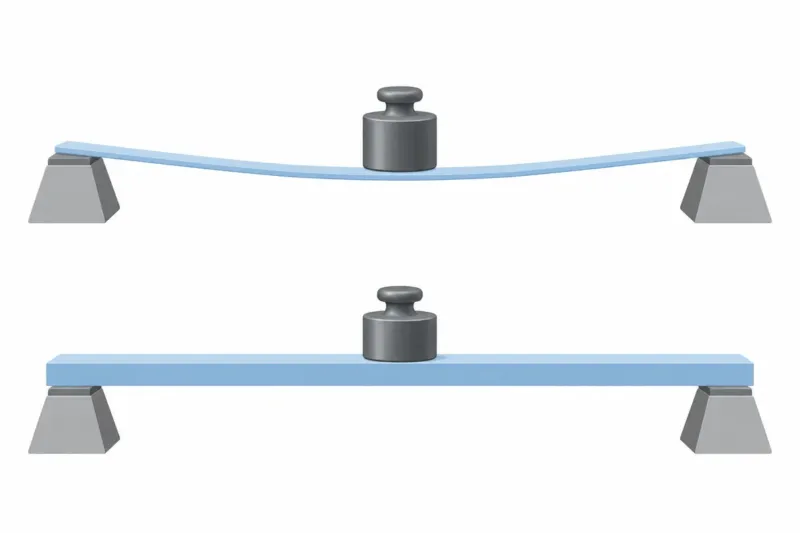
On a brick machine, a pallet that stays flat under vibration produces bricks of the same height on every stroke. A pallet that flexes produces uneven bricks and more rejections.
Choosing the Right Pallet Thickness for Your Machine
Different plants use different machines, from manual egg-layer machines to fully automatic hydraulic plants. The right thickness depends on your machine type and on how pallets are moved inside your plant.
- Manual / Egg-Layer Machines: 12 mm thickness (lightweight and easy to carry by hand)
- Semi-Automatic Machines: 18 mm – 20 mm thickness (handles vibration and shock)
- Fully Automatic Hydraulic Machines: 25 mm thickness (stays flat under fast, continuous vibration)
- Cement Block Machines: EcoRight Cement Block Pallet manufactured by AS Polywood Industries, 900 × 400 mm, 30 mm thickness
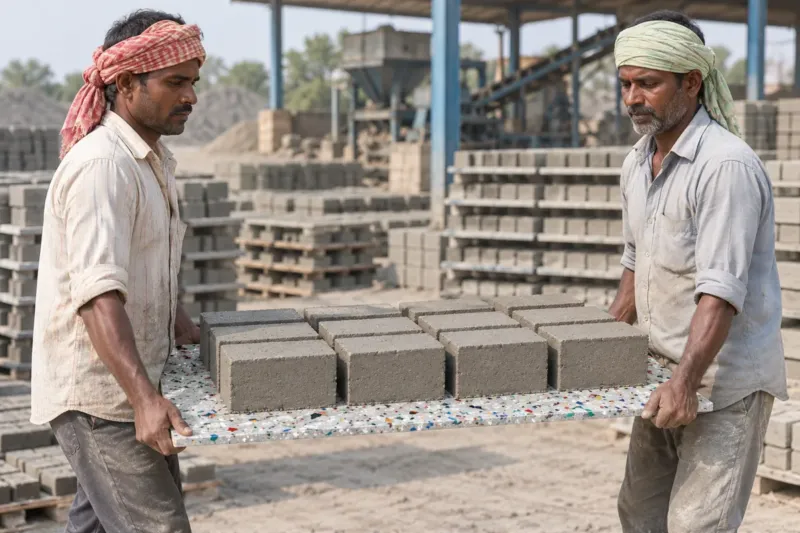
A thicker pallet is also a heavier pallet. If your workers carry pallets by hand, the extra weight adds up over a full shift. The best choice is the thinnest pallet that stays flat on your machine.
If you are unsure between two thicknesses, ask us for a sample pallet and run it on your own machine for a few days before placing a full order.
Material Comparison: Wood vs HDPE vs PVC Pallets
Thickness decides stiffness, but the material decides how long the pallet keeps that stiffness.
| Feature | Wooden / Plywood Pallet | HDPE / Recycled Plastic Pallet | PVC Composite Pallet |
|---|---|---|---|
| Working Cycles | About 300–500 | 2,000+ | 10,000+ |
| Water Absorption | High (swells, rots, warps) | Waterproof | Waterproof |
| Brick Height Consistency | Changes as the pallet warps | Consistent | Consistent |
EcoRight pallets manufactured by AS Polywood Industries have a lab-tested water absorption of just 2.76% (ASTM D570) and are termite-proof. They are made with equal thickness in all four corners, so your bricks come out at the same height from one pallet to the next.
Checklist Before Ordering Fly Ash Brick Pallets
Keep these five details ready before you contact any pallet supplier. They are enough to decide the right size, thickness and material:
- Brick Weight: Weight of one fresh brick from your machine
- Bricks per Stroke: How many bricks your mould makes at one time
- Mould Size: Mould dimensions or machine model
- Machine Type: Manual, semi-automatic or fully automatic
- Handling Method: Pallets moved by hand or by stacker
Conclusion
A fresh fly ash brick weighs about 3–3.5 kg, so a full pallet usually carries only 30–45 kg. This load is far below what a good quality pallet can handle. What actually wears pallets out is vibration, pressing, bending, water and rough handling.
That is why pallet thickness should be chosen for stiffness, and pallet material for water resistance and life. Pick the thinnest pallet that stays flat on your machine, in a waterproof material, and your bricks will come out uniform cycle after cycle.
Frequently Asked Questions
How much does a fly ash brick weigh?
A fresh standard 230 × 110 × 70–75 mm fly ash brick weighs about 3 to 3.5 kg, depending on the mix. Weigh a fresh brick from your own machine for the exact figure.
Can a plastic pallet carry the weight of fly ash bricks?
Yes. A full stroke of bricks usually weighs well under 50 kg, while the material of EcoRight pallets manufactured by AS Polywood Industries showed a compressive strength of 50.17 N/mm² in the CIPET test. Vibration and handling wear out a pallet long before brick weight does.
Which pallet thickness is best for a fully automatic brick machine?
For fully automatic hydraulic machines, a 25 mm pallet is recommended. It stays flat under fast, continuous vibration.
Does a thicker pallet make better bricks?
A stiffer pallet stays flat in the machine, which keeps brick height uniform. But choose only as much thickness as your machine needs, because a thicker pallet is heavier to carry.
Why are my bricks coming out with uneven height?
A pallet that is no longer flat is a common cause. Wooden pallets absorb water and warp, and thin pallets can flex under vibration. A waterproof pallet with equal thickness in all corners helps keep brick height uniform.
Can I get pallets made for my machine?
Yes. EcoRight pallets manufactured by AS Polywood Industries are available in custom sizes and thicknesses. Share your machine model or mould size and we will send you a quote.
Get in Touch: EcoRight Pallets Manufactured by AS Polywood Industries
- Company: AS Polywood Industries (EcoRight Brand)
- Founders: Annapurna Singh and Angad Singh Jaidka
- Address: 32-A, Sector C, Sanwer Road Industrial Area, Indore (M.P.) 452015
- Phone / WhatsApp: +91 98269 06262
- Product Page: EcoRight Fly Ash Brick Pallets
Need Recycled Plastic Products?
Contact us for pricing, custom sizes, and bulk orders. Fast delivery across India.