Fly Ash Bricks vs Red Bricks vs AAC Blocks: Which Is Best?
Fly ash bricks, red clay bricks, AAC blocks and concrete blocks are the four main walling materials used in India today. Each has its own Indian Standard, its own strength range and its own best use. This blog compares them side by side using the numbers in those standards, and then answers the real question: which one is best for your building?
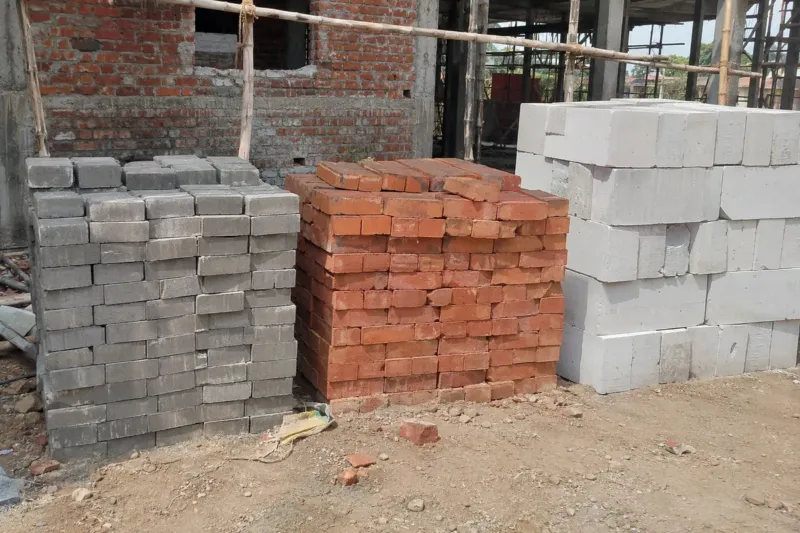
How Each Material Is Made
- Fly ash bricks are made from fly ash, lime or cement, gypsum and sand or stone dust. The mix is pressed in a machine and cured with water. They are not fired. IS 12894:2002 calls them “chemically bonded” bricks, because fly ash and lime react with moisture to form the binder.
- Red clay bricks are moulded from soil and burnt in a kiln. They are covered by IS 1077:1992.
- AAC blocks (autoclaved aerated concrete) are light blocks full of small air cells, cured with steam under pressure in an autoclave. They are covered by IS 2185 (Part 3).
- Concrete blocks (solid or hollow) are made from cement and aggregates and cured. They are covered by IS 2185 (Part 1):2005.
Side-by-Side Comparison as per Indian Standards
| Property | Fly ash brick | Red clay brick | AAC block | Concrete block |
|---|---|---|---|---|
| Indian Standard | IS 12894:2002 | IS 1077:1992 | IS 2185 (Part 3):1984 | IS 2185 (Part 1):2005 |
| Fired in a kiln? | No | Yes | No (autoclaved) | No |
| Strength classes | 3.5 to 30 N/mm² | 3.5 to 35 N/mm² | 1.5 to 7.0 N/mm² (by density and grade) | 3.5 to 15 N/mm² (by grade) |
| Water absorption limit | 20% up to Class 12.5, 15% above | 20% up to Class 12.5, 15% above | Not set in Table 1 | 10% by mass |
| Density | Not set | Not set | 451 to 1,000 kg/m³ | 1,100 kg/m³ and above (by grade) |
| Standard sizes | 190×90×90 mm, 230×110×70 mm and others | Same as fly ash bricks | Larger blocks | Larger blocks |
A few points from the standards are worth noting:
- Fly ash and red bricks follow the same rules for size, absorption and efflorescence. IS 12894 and IS 1077 have the same standard sizes and the same water absorption limits. So a good fly ash brick can be used wherever a red brick of the same class is used.
- AAC is much lighter. IS 2185 (Part 3) covers AAC blocks up to 1,000 kg/m³. Its Table 1 gives minimum strength of 2.0 to 7.0 N/mm² for Grade 1 blocks and 1.5 to 6.0 N/mm² for Grade 2 blocks, depending on density.
- AAC insulates best. The same table gives thermal conductivity of 0.21 to 0.42 W/m·K across the density range. Lower conductivity means less heat passes through the wall.
- Concrete blocks come in three grades. Under IS 2185 (Part 1), Grade A hollow blocks are at least 1,500 kg/m³ and made for 3.5 to 15 N/mm²; Grade B hollow blocks are 1,100 to 1,500 kg/m³; Grade C solid blocks are at least 1,800 kg/m³. Water absorption must not exceed 10% by mass.
Fly Ash Bricks vs Red Bricks
These two are the most common choice for houses, so they are compared most often.
Strength and finish
Both are sold by strength class, and both standards go up to high classes. In practice, the class you get depends on the plant. Fly ash bricks are pressed in steel moulds, so their size and edges are usually more even than hand-moulded clay bricks, which helps in laying and plastering.
Environment
Red bricks use soil and are fired with fuel. A 2011 study on cleaner walling materials in India, supported by the Shakti Sustainable Energy Foundation, found that fired clay bricks have higher embodied energy than non-fired materials, whatever the kiln. It also found that walls made with non-fired materials have lower CO₂ emissions on average. Fly ash bricks use an industrial waste instead of soil and are not fired.

Quality varies by plant
Fly ash bricks are only as good as the plant that makes them. In a 2019 survey, the Centre for Science and Environment tested fly ash bricks from 51 units in Delhi-NCR and found that 84% were below 7.5 N/mm². The fix is simple: buy from a plant that tests its bricks and can show the class on a test report. We explain the reasons for weak bricks in our blog on common problems in fly ash brick production.
Fly Ash Bricks vs AAC Blocks
AAC blocks are much lighter and insulate better, so they reduce the dead load on a framed building and keep rooms cooler. The CATF 2011 study found that AAC wall assemblies had the lowest U-value (best insulation) of all the walls it studied. The same study found that non-fired walls generally cost less than fired brick walls, with AAC walls as the exception.
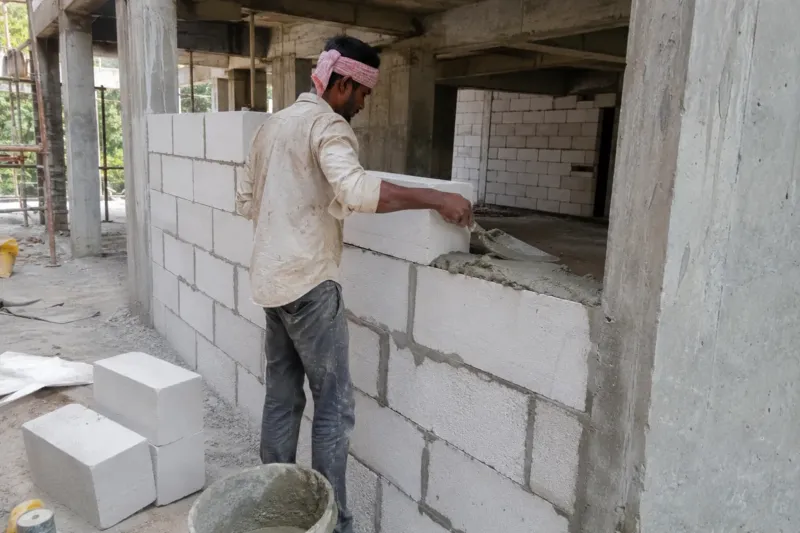
Fly ash bricks are stronger per unit. Their strength classes go up to 30 N/mm², against a maximum of 7.0 N/mm² in the AAC table. So fly ash bricks suit load-bearing walls, compound walls and places where the wall takes knocks, while AAC suits infill walls in RCC frames.
Where Concrete Blocks Fit
Concrete blocks are bigger than bricks, so a wall goes up with fewer units and fewer joints. Solid blocks are heavy (at least 1,800 kg/m³), while hollow blocks are lighter. They are common for compound walls, factory walls and load-bearing walls where a plain block finish is fine.
Which Is Best? Choose by Use
| Your need | Best choice | Why |
|---|---|---|
| Load-bearing walls of a house | Fly ash brick (or red brick) of the right class | High strength classes, standard brick size |
| Infill walls in a high-rise RCC frame | AAC block | Light weight, best insulation |
| Lowest environmental impact | Fly ash brick or AAC block | Not fired, use fly ash |
| Compound and factory walls | Fly ash brick or concrete block | Strong, fast to build |
| Exposed brickwork with no plaster | Class 12.5 bricks | IS 2212 asks for Class 12.5 for facing work |
For most Indian houses, a tested fly ash brick of the right class is the best overall choice: same size and rules as a red brick, even shape, and no firing. For tall framed buildings, AAC blocks save weight and improve insulation. Whatever you choose, ask for the class or grade and a test report. Government work often sets the class too. CSE notes that CPWD asks for Class 10 fly ash bricks above plinth level up to the fifth floor.
For Fly Ash Brick Manufacturers
Buyers now compare fly ash bricks with red bricks and AAC on strength, size and finish. Even, well-shaped bricks start with a flat, firm base under the brick while it is still soft. Read why waterproof pallets matter and see EcoRight fly ash brick pallets, rated for 10,000+ working cycles.
Conclusion
Fly ash bricks and red bricks follow the same size and water absorption rules, but fly ash bricks are not fired and use waste instead of soil. AAC blocks are the lightest and insulate best, so they suit framed buildings. Concrete blocks build fast and suit compound and factory walls. The best material is the one that fits the wall’s job, bought in a tested class.
Frequently Asked Questions
Are fly ash bricks better than red bricks?
For most uses, yes, if they are tested. They follow the same size and water absorption limits as red bricks, have more even shape, and are not fired. Buy by strength class with a test report.
Which is stronger, fly ash brick or AAC block?
Fly ash bricks. IS 12894 has classes up to 30 N/mm², while the AAC table in IS 2185 (Part 3) goes up to 7.0 N/mm². AAC is lighter and insulates better.
Can fly ash bricks be used for load-bearing walls?
Yes, in the right class. CSE notes that CPWD specifies Class 10 fly ash bricks for structures above plinth level up to the fifth floor.
What is the water absorption of fly ash bricks?
IS 12894 allows up to 20% by mass for classes up to 12.5 and up to 15% for higher classes, the same as red clay bricks under IS 1077.
Which brick is most eco-friendly?
Non-fired materials such as fly ash bricks and AAC blocks. A 2011 walling materials study found that fired clay bricks have higher embodied energy and walls made with non-fired materials have lower CO₂ emissions on average.
Get in Touch: EcoRight Pallets Manufactured by AS Polywood Industries
- Company: AS Polywood Industries (EcoRight Brand)
- Address: 32-A, Sector C, Sanwer Road Industrial Area, Indore (M.P.) 452015
- Phone / WhatsApp: +91 98269 06262
- Product Page: EcoRight Fly Ash Brick Pallets
Need Recycled Plastic Products?
Contact us for pricing, custom sizes, and bulk orders. Fast delivery across India.